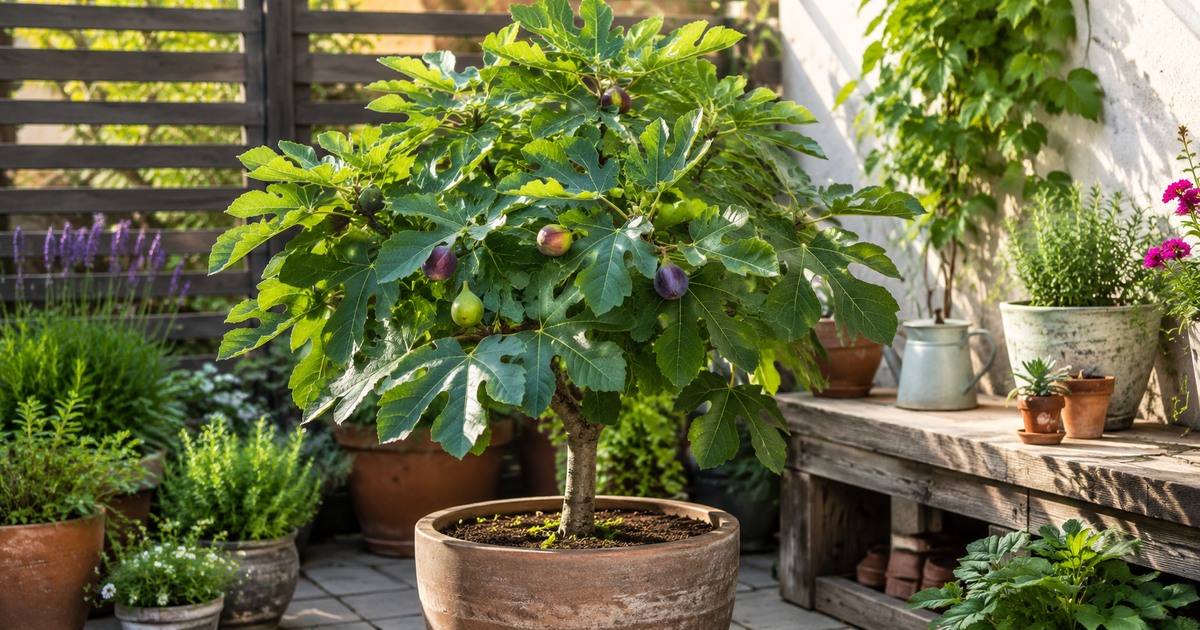
Figs suit small gardens because they can be trained, container-grown, and pruned to a manageable size. They also invite confusion: varieties differ in cold tolerance and pollination needs, fruit does not continue ripening well after picking, and a tree can grow vigorously without maturing a crop in a short season.
Choose a variety for the climate
Ask how long the warm season is, how cold winter becomes, and whether the variety produces a reliable main crop without a specialised pollinator. A locally proven variety is often more useful than one selected only for catalogue flavour descriptions.
Give container roots enough volume
Start with a pot large enough to buffer heat and moisture but not so large that the mix remains saturated. Increase size in stages. A stable container is important because a top-heavy tree can tip in wind. Use a free-draining mix and keep drainage openings clear.
Water for steady growth
Figs tolerate some dryness once established, but container trees can drop leaves or fruit when severely stressed. Water deeply, then allow appropriate drying. During fruit swelling, avoid dramatic cycles between drought and saturation.
Prune with the crop in mind
Remove dead or crossing wood and keep the framework accessible. Heavy pruning can delay fruit if it removes the growth that would carry the crop. In cold climates, some gardeners grow several flexible stems so the plant is easier to protect or renew after winter damage.
Do not overfeed a vigorous tree
Excess nitrogen can produce long leafy shoots and delay ripening. Feed container trees modestly when growth or a known deficiency justifies it. Garden trees in reasonable soil may need little beyond mulch and organic matter.
Prepare for winter before frost
Container roots are more exposed than roots in the ground. Move the dormant pot to a protected unheated location suitable for the variety, or insulate it according to local conditions. Avoid keeping a dormant fig warm and dark for months.
Harvest by softness and droop
A ripe fig usually softens, hangs downward, and develops full colour for the variety. Pick gently because ripe skin bruises easily. Protect fruit from birds or wasps with physical barriers where needed, checking them frequently.
Use the whole small-fruit plan
If you are building a patio fruit collection, compare container size and support needs with container raspberries and the acidity requirements in the blueberry guide. A few well-sited fruit plants are easier to maintain than many undersized pots.
Breba and main crops
Some figs produce an early breba crop on wood formed the previous year and a later main crop on new growth. Winter damage or hard pruning can remove breba-bearing wood. Knowing which crop is important in the local climate helps determine how much old wood to preserve.
Ripening is the real climate test
A tree may set many figs that never soften before cold weather. In short seasons, choose early varieties, maximise warmth and sun, and avoid excessive late nitrogen. Removing very late tiny fruit may help the tree direct resources, but do not strip a productive branch without understanding the variety’s cycle.
Root pruning a mature container fig
When the tree must stay in the same pot, dormant-season root pruning can remove part of the outer root mass and make room for fresh mix. This is stressful work: use clean tools, keep a balanced root system, reduce top growth modestly if needed, and protect the recovering tree from extremes.
Winter protection options
- Move a dormant pot to an unheated protected space where temperatures remain suitable for the variety.
- Insulate the container and shelter it from winter rain while allowing drainage.
- For an in-ground multi-stem fig, bundle and protect stems only with a method appropriate to the local climate.
- Avoid warm dark indoor storage that encourages weak growth.
Pests and splitting
Birds and wasps are attracted to ripe fruit. Use netting safely and check it so wildlife cannot become trapped. Splitting can follow rain after a dry period or occur in susceptible varieties. Consistent moisture and timely harvest reduce losses but cannot eliminate weather effects.
Propagating a proven local tree
Figs are commonly propagated from dormant cuttings. Use clean, healthy wood from a known plant, label the variety, and avoid distributing material where local plant-health rules restrict movement. A local successful tree may be better adapted than an unnamed novelty.
Fig hardiness across climates
Figs are native to Mediterranean and West Asian dry-summer climates but are unusually adaptable. They fruit reliably outdoors in Köppen Csa, Csb, and Cfa zones, and many gardeners in cooler continental climates (Köppen D) succeed with cold-hardy varieties protected by heavy mulch or by bending and burying young canes for winter. In humid tropical climates, figs grow vigorously but may produce a less concentrated, watery crop; thinning fruit and improving airflow helps. Southern Hemisphere gardeners should expect the main harvest in roughly January through March, the seasonal equivalent of a Northern Hemisphere summer crop.
Fig tree care: quick answers
Why isn’t my fig ripening fruit before the season ends?
This is often a climate-length issue rather than a care problem. Favor early-ripening varieties or extend the season with winter protection in shorter growing seasons.
Should I prune a fig tree hard every year?
Pruning should match your crop goal. Overly hard annual pruning on certain varieties can remove the wood that would have produced fruit.
How do I protect a container fig over winter?
Move it to an unheated but frost-free space, or in mild climates, group containers together against a sheltered wall.