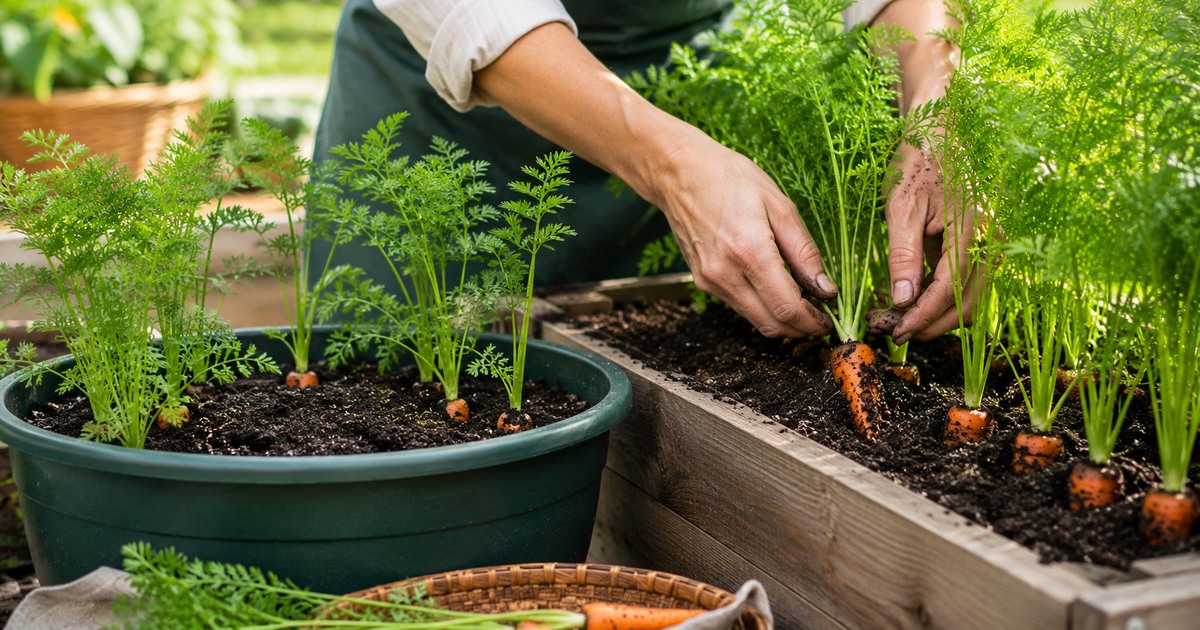
Carrots are not difficult because they need rich soil or constant feeding. They are difficult because tiny seeds germinate slowly and the roots need loose, evenly moist soil from the beginning. Containers and raised beds can help when native soil is stony or compacted, but only if the container is deep enough and does not dry out every afternoon.
Match the variety to the available depth
Long storage carrots need a deep, stone-free root run. Shorter Chantenay, Parisian, or mini types are more forgiving in shallower containers. Read the mature root length on the seed packet and provide extra depth below it. A broad container also buffers moisture better than a narrow decorative pot.
Prepare a fine surface without packing it hard
Use a loose mix that drains yet holds moisture. Break up clods and remove large stones or woody pieces from the top several inches. Do not add fresh manure or a large dose of nitrogen, which can encourage forked roots and excessive top growth.
Sow directly and keep the surface damp
Carrots dislike transplanting because the taproot begins early. Sow shallowly, cover lightly, and water with a fine spray. A thin board, burlap, or light fabric can help conserve surface moisture during germination, but remove it as soon as seedlings appear. Check daily because a dry crust can stop emergence.
Thin even when it feels wasteful
Crowded seedlings produce small or twisted roots. Thin when plants are manageable, leaving spacing suited to the variety. Cut unwanted seedlings at soil level if pulling them would disturb the neighbours. A second thinning can provide baby carrots later.
Water deeply and consistently
Alternating drought and heavy watering can split roots and create poor texture. Containers may need frequent checks, especially in wind. Mulch lightly after seedlings are established; the material choices in the vegetable mulch guide help prevent a hard surface without burying tiny plants.
Protect the shoulders
Some varieties push above the soil and develop green shoulders in light. Pull a little soil or fine mulch over exposed tops. Watch for carrot rust fly and other local pests, using barriers only where they are relevant in your region.
Harvest without snapping the roots
Water the day before harvest if soil is dry. Loosen the soil beside long roots with a fork rather than pulling only on the leaves. Carrots can be harvested at usable size, so taste a few instead of waiting for every root to reach a catalogue measurement. For a continuous supply, apply the timing method in the succession planting guide.
Container size and watering capacity
A shallow window box may grow round or very short carrots, but long varieties need real depth. More soil volume also slows drying. Dark pots in full sun can become hot, so choose a light-coloured or insulated container where summers are intense. Confirm that drainage holes do not become blocked by a flat surface.
Three ways to improve germination
- Sow into pre-moistened soil and water with a fine rose so seed is not displaced.
- Keep the surface covered lightly with fabric, cardboard, or a board, checking daily and removing it at emergence.
- Mix a small amount of radish seed into the row as a quick marker, removing radishes early enough to leave carrot space.
Why roots fork, grow hair, or stay small
| Problem | Likely contributors | Next-season change |
|---|---|---|
| Forked roots | Stones, compaction, fresh manure, root disturbance | Prepare deeper, cleaner soil and direct sow |
| Hairy roots | Stress, excessive fertility, disease or root injury | Moderate feeding and improve conditions |
| Small roots | Crowding, shade, drought, early harvest | Thin, improve light and keep moisture steady |
| Split roots | Drought followed by heavy watering | Use consistent moisture and light mulch |
Pest and disease awareness
Carrot pests differ by region. Fine mesh may exclude some flies when installed before adults lay eggs, but it must be sealed and compatible with local recommendations. Remove badly diseased foliage and rotate the carrot family when recurring problems appear. Do not treat every leaf spot with a general spray.
Harvest and storage
Remove tops after harvest because leaves continue drawing moisture from the root. Cool carrots promptly. For longer storage, use a method that maintains high humidity without allowing rot, following local food-storage guidance. Damaged roots should be used first rather than stored.
A realistic container harvest
Container carrots vary in size because moisture and spacing vary across the pot. Judge success by flavour and usable roots, not supermarket uniformity. A second sowing may perform better after the gardener learns how quickly that particular container dries.
Growing carrots in containers: quick answers
Why do my carrots come out forked or hairy?
This usually points to compacted soil, recent fresh manure, or inconsistent moisture rather than the variety itself.
How deep does a container need to be for carrots?
Match depth to the variety. Many short, round types do well in 20-25cm of depth; long varieties need considerably more.
Is thinning carrot seedlings really necessary?
Yes. Crowded carrots compete for root space and rarely size up properly if left unthinned.