Humidity advice is often reduced to “mist daily,” but plants respond to the moisture level of the surrounding air over time, not to a brief spray that evaporates in minutes. Some tropical plants show better leaf quality in moderately humid rooms. Others tolerate ordinary household conditions as long as roots, light, and temperature are suitable.
Start with the plant and the room
Thin-leaved ferns, calatheas, and some young tropical plants often react sooner to dry air than snake plants, succulents, or thick-leaved peperomias. Measure the room with a basic hygrometer before assuming humidity is low. Kitchens and bathrooms may be humid at certain times but dry for most of the day.
What dry air can look like
Brown leaf edges, curling, and slow unfurling can be associated with low humidity, but they are not proof. Mineral-heavy water, damaged roots, excessive fertiliser, sun scorch, and inconsistent watering can create similar symptoms. Check the whole care pattern before adding a humidifier.
Misting has limited reach
Misting may clean leaves or temporarily wet a surface, but it usually does not raise room humidity for long. Repeated wet foliage can also be unhelpful where air movement is poor. If a species is prone to spotting or fungal problems, avoid making wet leaves part of the daily routine.
Methods that change the air more consistently
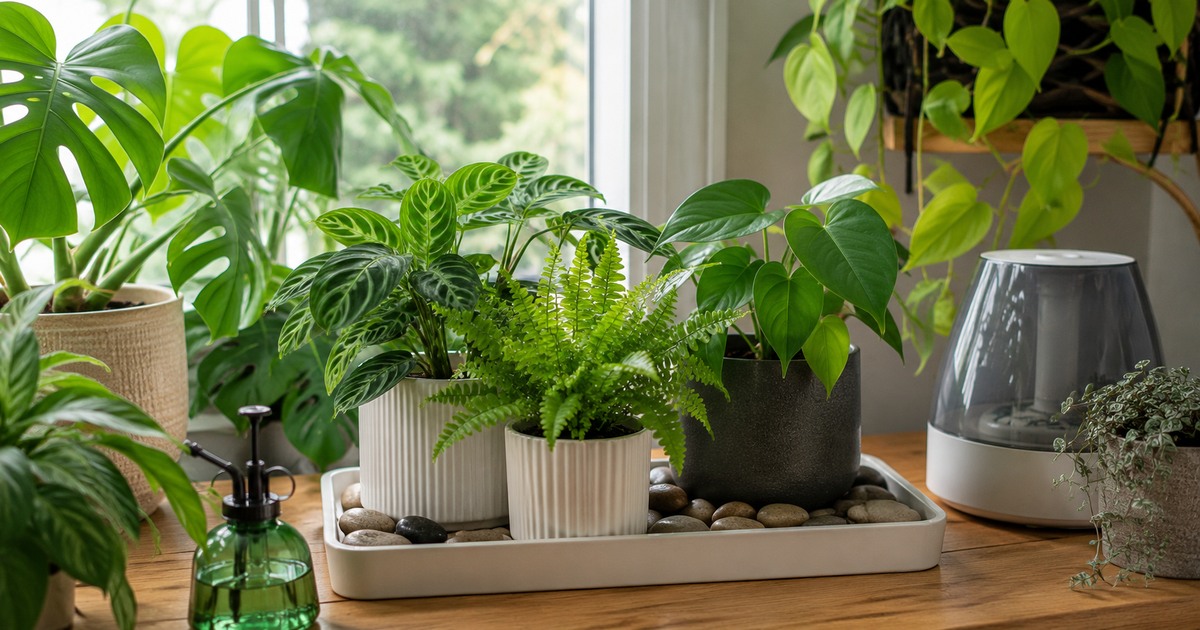
- Use a properly maintained room humidifier and clean it as directed.
- Group compatible plants, leaving enough space for airflow.
- Keep plants away from direct blasts of heated or cooled air.
- Choose naturally more humid rooms only when light is also adequate.
Pebble trays have a small local effect at best unless evaporation is substantial, and the pot must sit above the water rather than in it.
Do not trade dry air for wet roots
People often water more when leaves look crisp. That can create root problems without changing air humidity. Follow the soil-based checks in the houseplant watering guide. During winter, coordinate humidity with the slower-light routine in the winter care guide.
A practical target is stability
Many common houseplants adapt to a stable room better than to repeated swings between very dry and very humid conditions. Make modest changes, watch new leaves, and choose species that suit the home. If a plant needs greenhouse-like humidity to remain presentable, a closed cabinet or terrarium may be more realistic than changing the climate of the entire house.
Measure before changing the room
A small digital hygrometer can show whether a room is consistently dry or only dips during part of the day. Place it near the plants but not directly above a humidifier or beside a shower. Record morning and evening readings for a week. This prevents solving a humidity problem that does not exist while overlooking light or root conditions.
Humidifiers need maintenance
Use the water and cleaning method recommended by the manufacturer. Mineral-rich mist can leave deposits on leaves and furniture. A neglected reservoir can support microbial growth. Position the unit so vapour disperses through the room rather than wetting one group of leaves or a wall. Electrical safety and ventilation matter as much as the target humidity.
Plant cabinets and terrariums are different tools
A cabinet can maintain a humid microclimate for species that struggle in an ordinary room, but it also concentrates heat, condensation, and pests. Use fans where appropriate, monitor temperature, and avoid overcrowding. Closed terrariums suit small plants with compatible moisture needs, not every tropical houseplant.
A symptom comparison
| Observation | Possible dry-air link | Other checks |
|---|---|---|
| Brown crisp edges | Possible on thin leaves | Water quality, salts, root dryness, sun |
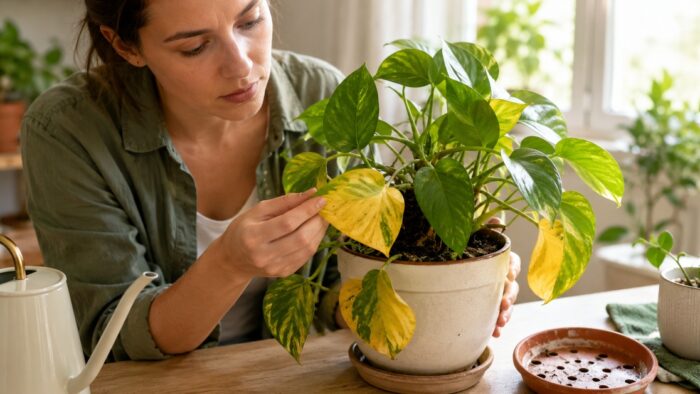
| Soft yellow leaves | Usually not caused by dry air alone | Wet mix, root damage, low light |
| Leaf fails to unfurl | Humidity may contribute | Pests, mechanical damage, weak roots |
| Fine webbing and stippling | Dry rooms favour mites | Inspect for spider mites |
Choose plants that match the home
A collection becomes easier when the most demanding species are concentrated in one managed area and tolerant plants occupy ordinary rooms. Snake plants, ZZ plants, many pothos, hoyas, and peperomias generally adapt more easily than plants that require consistently high humidity. Selection can solve what equipment cannot.
Avoid an all-or-nothing target
The aim is a reasonable, stable range for the plants and people in the room. Excessive humidity can encourage condensation, mould, and damage to the home. Make modest changes, watch new growth, and adjust only when the evidence points in that direction.
Houseplant humidity: quick answers
Does misting actually raise humidity for houseplants?
Only briefly. Misting evaporates within minutes and does little to change the sustained humidity around a plant.
What works better than misting?
Grouping plants, a room humidifier, or a pebble tray with water beneath (not touching) the pot all sustain higher humidity for longer.
Can too much humidity cause problems?
Yes. Persistently wet leaves and stagnant air encourage fungal issues, so airflow needs to be balanced against added moisture.