A few tiny flies around a pot can become an exhausting indoor problem, but fungus gnats are usually a moisture-management issue before they are an insecticide issue. Adults are annoying; the larvae live in damp organic potting mix and feed mainly on fungi and decaying material. Heavy populations can also disturb tender roots, especially in seedlings and recently rooted cuttings.
Make sure they are fungus gnats
Fungus gnats are small, dark, delicate flies that often run across the soil or lift off when a pot is moved. Fruit flies are more interested in ripe produce and drains. Shore flies are stronger fliers and are associated with algae and very wet growing areas. Identification matters because a treatment aimed at the wrong breeding site will not solve the problem.
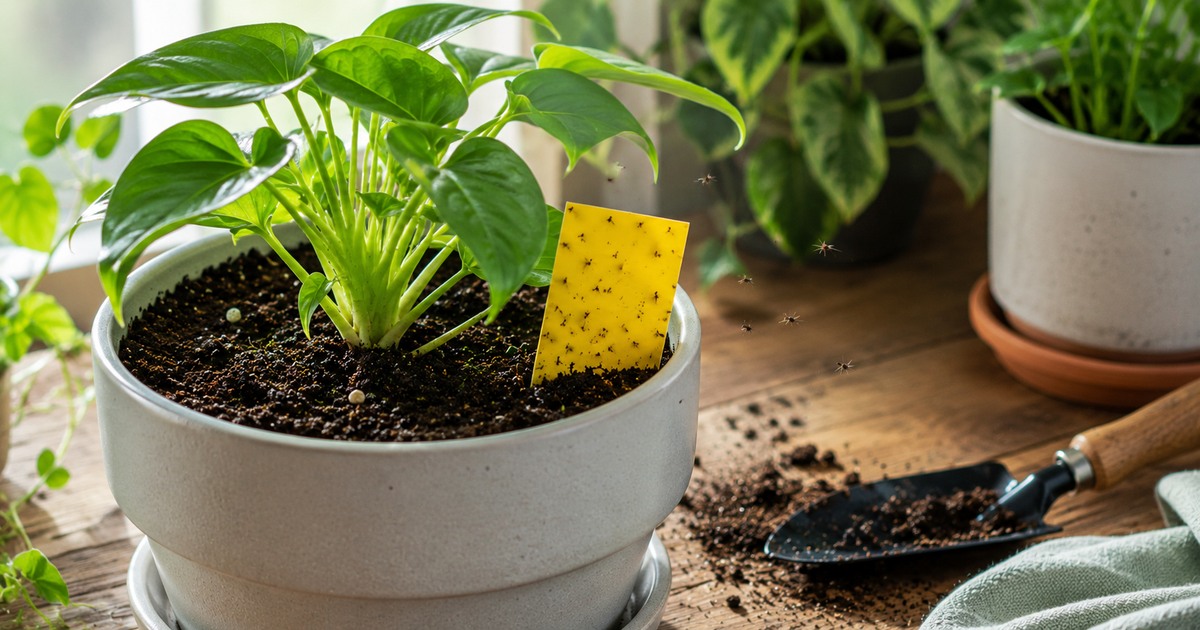
Place a yellow sticky card near the soil surface for several days. Adults caught there confirm activity, but the card does not show how many larvae remain. A slice of raw potato placed cut-side down on the mix can sometimes attract larvae underneath, making them easier to see.
Change the conditions in the pot
Allow the upper layer of mix to dry to the depth that is safe for the plant. Drought-tolerant species can dry more deeply than ferns, seedlings, or moisture-loving tropical plants. The goal is not to dehydrate every plant; it is to stop keeping the whole pot continuously wet.
- Empty water from saucers and decorative outer pots.
- Move pots away from chronically dark positions if the species can take more light.
- Remove fallen leaves and dead flowers from the surface.
- Check whether the pot is much larger than the root system.
- Use the moisture checks in the houseplant watering guide instead of watering by weekday.
Use traps for monitoring, not as the only control
Sticky cards reduce the number of egg-laying adults and show whether the population is falling. Replace cards when they become dusty or full. Place them close to pots rather than across the room. Traps cannot reach larvae in the mix, so a falling adult count is meaningful only when moisture and sanitation have also changed.
When a biological larvicide may help
Products containing the appropriate strain of Bacillus thuringiensis israelensis are used in some regions against fly larvae. Availability and labels differ, so use only a product whose label includes the intended indoor or container use. Repeat applications may be needed because eggs and adults are present at different stages. Beneficial nematodes are another option for larger collections, but they need correct storage and moisture to work.
Do not repot every affected plant immediately
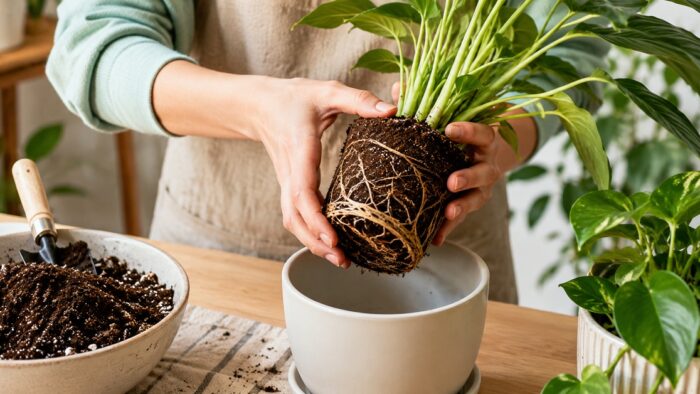
Repotting can remove some larvae, but it also stresses roots and may spread insects through shared tools or spilled mix. Reserve it for pots with collapsed media, poor drainage, root damage, or a size mismatch. If roots smell sour or feel soft, follow the more careful steps in the root rot recovery guide.
Why the gnats keep returning
Open bags of damp potting mix, propagation trays, self-watering reservoirs, and one overwatered plant can maintain the population. Inspect the whole collection, not only the pot with the most visible adults. New plants should spend time apart from established ones, as described in the houseplant pest guide.
A realistic end point
Adults may continue appearing for several weeks after conditions improve because the life cycle is not interrupted in a day. Look for a steady decline rather than an instant disappearance. Once numbers are low, keep sticky cards as monitors and return to plant-appropriate watering instead of maintaining an artificial drought.
A four-week response that fits the insect life cycle
During the first week, stop routine watering and check every pot in the room. Empty saucers, remove surface debris, and place sticky cards close to the worst pots. Water only species that have reached their normal dry point. In the second week, continue moisture control and apply a labelled larval treatment if the infestation is heavy or sensitive young plants are present. Replace traps so the adult count remains readable.
Weeks three and four are about trend rather than perfection. A few adults may still emerge from eggs or pupae that were already present. What matters is whether the number caught each week is falling. If it is not, look for a missed reservoir: propagation domes, moss poles kept constantly wet, self-watering planters, damp bags of mix, or one large pot that never dries.
Plants that cannot be dried aggressively
Ferns, young seedlings, carnivorous plants, and some tropical species can be damaged by the “let everything dry completely” advice. For these plants, improve drainage and airflow while keeping the root zone appropriately moist. A thin surface layer of coarse material may make the top less inviting, but it does not correct saturated mix below. Biological larval control is often more suitable than forcing a moisture-loving plant into drought.
Common fixes that disappoint
- Pouring household bleach, vinegar, essential oils, or strong soap into the pot can injure roots and does not provide controlled long-term management.
- Covering wet mix with decorative stones may hide the surface while keeping it damp underneath.
- Using sticky traps alone catches adults but leaves the breeding conditions unchanged.
- Repotting every plant on the same day creates stress and can spread insects through shared tools and spilled soil.
- Watering from below does not automatically solve the problem if the mix remains wet for long periods.
When replacing the mix is reasonable
Repot when the media has collapsed, smells sour, drains poorly, or supports a plant with damaged roots. Bag the discarded mix, clean the pot, and avoid scattering it around other plants. A valuable plant with severe root decline may need both pest control and the recovery steps in the root-rot article. A badly affected tray of inexpensive seedlings can sometimes be replaced more efficiently than treated through several life cycles.
Prevention after the problem is gone
Store potting mix dry and closed, inspect new plants separately, and match pot size to root mass. Keep a few sticky cards as an early-warning system rather than waiting for adults to cover a window. Fungus gnats are common enough that an occasional adult is not a failure; the aim is to prevent a damp indoor breeding site from becoming permanent.
Fungus gnats in houseplants: quick answers
Are fungus gnats actually harmful to houseplants?
Adults are mostly a nuisance, but large larvae populations can damage fine roots, especially in seedlings and young plants.
Do fungus gnats mean I’m overwatering?
Often, yes. Their larvae need consistently damp organic matter in the top layer of potting mix to thrive.
How long does it take to clear an infestation?
Expect roughly four weeks to break the life cycle fully, since eggs, larvae, and adults overlap at different stages.