Healthy garden soil is built over seasons, not fixed in one afternoon. The best soil work is steady and practical: test when needed, add organic matter wisely, protect the surface, avoid compaction, and grow plants in a way that feeds the soil as well as the harvest.
Improve soil by measuring, covering, and feeding it gradually
Improve soil by testing pH and nutrients, adding compost in reasonable amounts, mulching, minimizing compaction, rotating crops, and keeping soil covered. Do not guess at amendments when a soil test can guide you.
Healthy soil is more than dark color
Soil is a living system of minerals, organic matter, air, water, microbes, roots, and small organisms. Good structure lets roots breathe and water move. Poor structure creates puddles, crusting, or hard clods that make plants struggle.
A season-by-season soil plan
- Start with a soil test to learn pH, organic matter, phosphorus, potassium, and other basics.
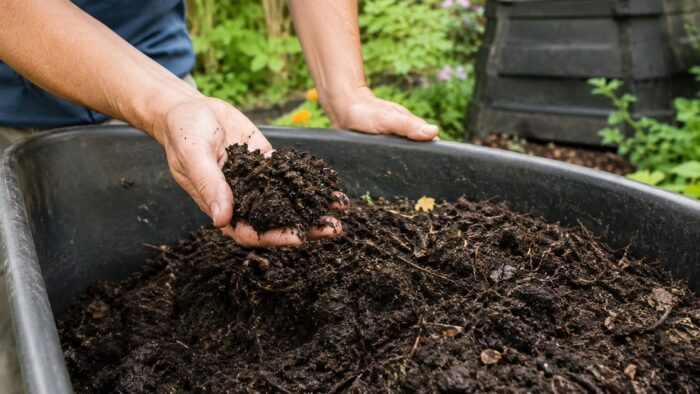
- Add mature compost, not unfinished scraps, to improve organic matter.
- Mulch the surface to reduce erosion, evaporation, and temperature swings.
- Avoid walking on growing beds, especially when soil is wet.
- Rotate plant families and remove diseased debris when appropriate.
Organic matter, structure, drainage, and biology
Sandy soils benefit from organic matter because it helps hold water and nutrients.
Clay soils benefit from organic matter because it improves aggregation and drainage over time.
More compost is not always better; excess nutrients and salts can cause problems.
Covering soil reduces crusting and supports soil life.
Earthworms are helpful indicators, but they are not the only measure of soil health.
A soil improvement plan should be measurable
Choose one or two indicators to track each year: infiltration after rain, soil test results, earthworm activity, root depth, or how quickly beds crust after watering. These observations show whether changes are improving structure rather than only changing appearance.
Add amendments in response to a need. Compost can increase organic matter, mulch can protect the surface, and reduced traffic can limit compaction. None of them replaces drainage work or a soil test when the underlying problem is unclear.
Avoiding unnecessary tillage
Frequent deep cultivation breaks soil aggregates and can bring buried weed seed to the surface. Use targeted loosening where roots need it, keep permanent paths, and avoid working wet soil.
Over time, mulch, roots, compost, and reduced foot traffic can improve structure with less disruption than repeated turning.
Tests and tools that guide better decisions
Spend money on a soil test, compost from a reliable source, mulch, and basic tools. Avoid buying lime, sulfur, or strong fertilizers unless the soil test or crop need supports it.
Why random amendments cause new problems
- Adding random amendments without knowing soil pH or nutrient levels.
- Working soil when it is wet, which causes compaction.
- Leaving beds bare through heat, rain, and wind.
- Expecting one bagged product to permanently transform poor soil.
Compaction, crusting, and poor infiltration
If water pools, check compaction, grade, and organic matter. If leaves are pale despite fertilizer, pH may be limiting nutrient availability. If plants grow unevenly, compare sun, water, and soil depth across the bed.
Track soil changes instead of relying on colour
Dark soil is not automatically fertile, and pale soil is not automatically poor. Keep a simple record of test results, compost additions, drainage observations, crop performance, and areas that stay wet. Comparing notes across seasons reveals whether a change actually helped.
Use compost to add organic matter, not as a substitute for testing every nutrient question. The guide on compost maturity explains when material is ready to use, while the soil pH guide shows why amendments should be gradual. Soil improvement is usually a series of modest corrections: protect the surface, avoid compaction, return organic residues safely, and grow roots through as much of the year as practical.
Garden soil questions
How often should I test garden soil?
Every few years is practical for many home gardens, or sooner when starting a new bed or solving a persistent issue.
Is compost enough to improve soil?
Compost helps greatly, but soil health also depends on pH, drainage, compaction, mulch, and plant management.
Should I till my garden every year?
Not necessarily. Frequent tilling can disrupt structure and bring weed seeds up. Use minimal disturbance where possible.
What is the fastest way to improve poor soil?
Add mature compost, mulch the surface, avoid compaction, and choose crops that suit the current conditions while improvements build.