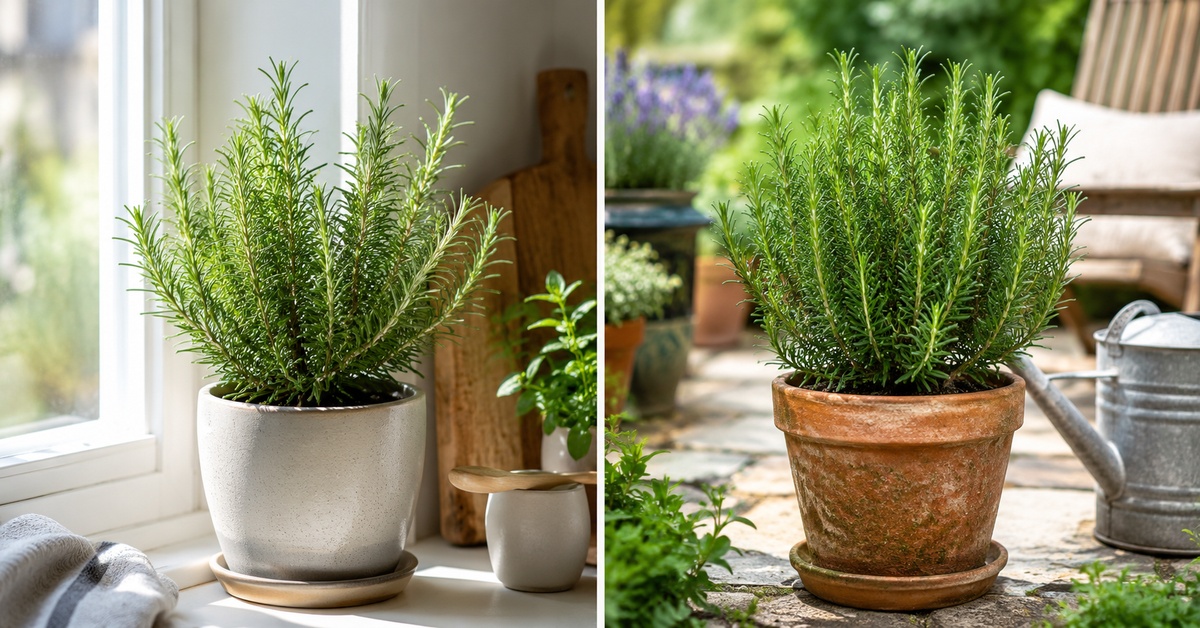
Rosemary prefers bright light, free-draining soil, and a root zone that is neither waterlogged nor neglected for long periods. It often grows well outdoors in summer but becomes difficult when moved into a warm, dry home for winter. Keeping it in a container from the beginning makes seasonal moves easier. Compare its needs with other indoor herbs and basil care, which require a different moisture rhythm.
Start with a healthy plant rather than seed
Rosemary seed is slow and variable. A nursery plant or rooted cutting provides a faster, more predictable start. Choose compact growth with good colour and no webbing, sticky leaves, or dead interior stems.
The pot and mix should drain quickly
Use a container with drainage holes and a loose potting mix. Rosemary tolerates short dry periods better than saturated roots. Terracotta can help moisture escape, but it also dries faster in hot weather, so the best pot depends on how often you can check it.
Outdoor care during the growing season
Place rosemary in full sun after gradual acclimation. Water deeply, then allow the upper part of the mix to dry before watering again. Avoid leaving the pot in a saucer filled with rainwater. Pinch or harvest soft tips to encourage branching, but do not remove most of the foliage at once.
Feed lightly. Very rich soil and frequent high-nitrogen fertilizer can produce soft growth with weaker aroma.
Moving rosemary indoors
Inspect for mites, aphids, whiteflies, and scale before bringing the plant inside. Transition it gradually to lower light and different humidity. A cool bright room is usually better than a hot shelf above a radiator.
Indoor rosemary often fails because roots stay wet while leaves lose moisture in heated air. Check the mix rather than following a fixed schedule, and keep air moving gently around the plant.
Why leaves turn brown
- Roots remained wet in dense mix
- The plant dried severely between waterings
- Light dropped sharply after moving indoors
- Hot dry air increased leaf moisture loss
- Spider mites or another pest went unnoticed
- Old woody growth shaded the centre of the plant
Pruning and harvest
Cut green flexible shoots and leave enough foliage for regrowth. Avoid cutting deeply into old bare wood unless the plant still has active buds below the cut. Regular light harvesting is safer than one severe trim.
Overwintering decisions
In climates where rosemary is not reliably hardy, a container can be moved to a protected bright place. Outdoor protection methods depend on local winter temperatures and the variety. Do not assume that a plant sold locally can survive every winter in an exposed pot.
When to replace the plant
A rosemary plant with widespread dieback, rotten roots, and no healthy basal growth may not recover. Taking cuttings from healthy tips earlier in the season provides insurance and often produces a more useful plant than nursing a declining woody specimen.
Propagation from cuttings
Take a non-flowering green shoot, remove the lower leaves, and place the cutting in a clean, airy medium. Keep it bright but out of harsh sun while roots form. Several cuttings provide insurance because not every one will root. Once new growth appears and the root ball holds together, move the plant into a small pot.
Cuttings preserve the characteristics of the parent plant and often establish faster than seed. They are also a practical way to replace an ageing rosemary before winter.
Humidity without wet foliage
Dry indoor air can stress rosemary, but constantly misting leaves is not a reliable solution and can encourage spotting in cool rooms. Use good spacing, moderate room humidity, and steady root-zone moisture. Keep the plant away from hot vents and inspect frequently for mites, which thrive in dry indoor conditions.
Pairing rosemary with other herbs
Rosemary shares a preference for sun and drainage with thyme, sage, and oregano, but mixed containers still need enough root space. Basil, parsley, and mint generally prefer more consistent moisture, so they are poor long-term partners in the same pot. A grouped display of separate containers gives a similar visual effect while allowing each herb to be watered correctly. It also makes it easier to move rosemary indoors without disturbing the rest of the planting.
Moving rosemary indoors without shocking it
Begin the transition before nights become very cold. Inspect the plant for insects, remove dead material, and move it first to a sheltered bright position. Indoors, give rosemary the strongest light available and keep it away from hot air blowing directly from a vent.
Watering usually needs to decrease indoors, but the root ball should not become dust-dry. The seasonal checks in the winter houseplant guide apply to rosemary as well. If you are comparing Mediterranean herbs, the thyme guide explains similar drainage needs. Expect some leaf drop after the move; improve light and airflow before assuming the plant needs fertiliser.
Rosemary across world climates
Rosemary is native to the Mediterranean Basin, a Köppen Csa/Csb climate of dry, sunny summers and mild, wet winters. In that environment it can live outdoors year-round as a woody perennial. Gardeners in humid tropical regions (Köppen A), such as parts of Southeast Asia, coastal Florida, or northern Australia, face the opposite challenge: rosemary rarely struggles with cold but rots quickly in constantly damp, humid air. In those climates, raise the pot, use a coarse mix, and prioritise airflow over winter protection. In continental and polar climates (Köppen D and E) – much of Canada, Scandinavia, and inland Eastern Europe – rosemary cannot survive an open winter and should be grown in a container that moves indoors well before the first hard frost, following the same light and watering reductions described in the winter houseplant guide.
The underlying rule does not change with geography: rosemary wants full sun, sharp drainage, and restrained watering. What changes is which season threatens the plant. In Mediterranean and dry-summer climates the risk is winter wet; in humid climates the risk is constant moisture in the air; in cold climates the risk is hard frost on unprotected roots.
Rosemary and climate: quick answers
Can rosemary survive outdoors in a tropical climate?
It can, but humidity and constant rainfall are usually a bigger risk than heat. Improve drainage and airflow rather than worrying about temperature.
Does rosemary need a cold winter to grow well?
No. Rosemary does not require winter chill to thrive; it simply needs protection from hard freezes where winters are severe.
Is rosemary timing different in the Southern Hemisphere?
The plant’s needs are identical, but the calendar flips: treat August as the Northern Hemisphere treats February, and plan the indoor move before the Southern Hemisphere’s autumn frosts rather than in October.